
Rail Fastening System in an Insulation
TINES® ERS
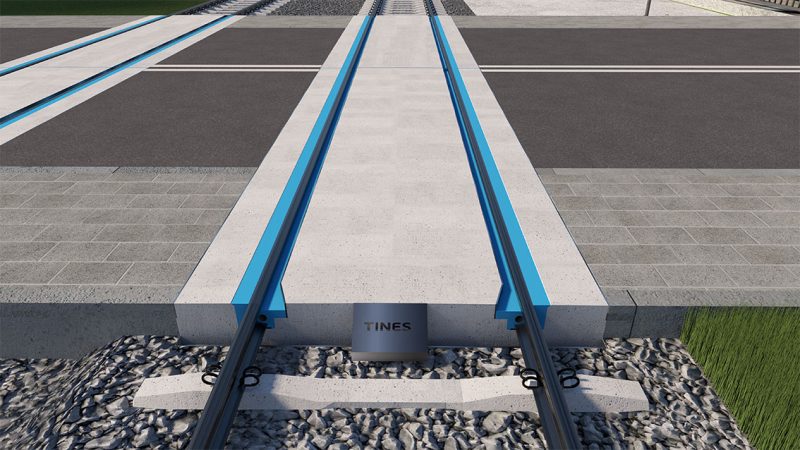
The rail fastening system in an insulation TINES® ERS is a type of direct rail fastening designed for constructing ballastless rail surfaces. The TINES® ERS rail fastening system in an insulation can be implemented on engineering structures (bridges, viaducts, and in tunnels), on pedestrian crossings, railway–road crossings, cycle paths, in junctions, and transshipment terminals, as well as in the form of an integrated railway–road surface together with the prefabricated TINES® LC-L rail slab.


System Description
The rail fastening system in an insulation TINES® ERS is a type of direct rail fastening intended for constructing ballastless rail surfaces.
In the TINES® ERS system, rails are fastened along their entire length in rail channels using the polyurethane elastomer TINES® Polyrail 60/65. This elastomer forms a permanently elastic, homogeneous rail insulation that fulfills two essential fastening functions, namely securing the rail within the rail channel and supporting the rail baseplate.
Thanks to the very good adhesion of TINES® Polyrail materials to concrete and steel surfaces, additional fastening of the rails in the rail channels using screw connections is not necessary.
Continuous fastening of the rails with the set of TINES® Polyrail materials ensures durable and elastic absorption of loads generated by train movements and temperature changes of the rails, i.e., loads acting in both vertical and horizontal planes. As a result, the TINES® ERS system effectively dampens vibrations and noise generated by train movements.
The material properties of the elastic rail insulation made of TINES® Polyrail 60/65 elastomer also positively influence the protection of the railway route’s surroundings against stray currents.
Optionally, the TINES® ERS system employs a continuous, elastic under-rail spacer TINES® Railstrip, which can serve as an additional element to modify the stiffness of the rail support according to specific design requirements.
System Application
The TINES® ERS rail fastening system in an insulation is designed for use in ballastless rail surface constructions on both single-track and multi-track lines, on conventional or broad-gauge routes (with track gauges of 1435 mm or 1520 mm). The system is applicable for fastening all Vignole rails, including, among others, those with profiles 60E1 and 49E1 as well as special rails. The TINES® ERS system can be used on straight sections and in horizontal curves with a radius R ≥ 150 m, for maximum rail vehicle axle loads up to 260 kN and a maximum permissible speed of 250 km/h. It is intended for use on railway networks or their segments, on metro infrastructure, and on branch lines.
The TINES® ERS rail fastening system in an insulation can be installed on engineering structures (bridges, viaducts, and in tunnels), on pedestrian crossings, railway–road crossings, bicycle crossings, in junctions, and transshipment terminals, as well as in the form of an integrated railway–road surface together with the prefabricated TINES® LC-L rail slab. The system is particularly dedicated to those sections where it is crucial to reduce the level of vibrations and noise emitted to the surroundings of the route during rail vehicle movements.
The TINES® ERS system constitutes a fastening system of categories C and D in accordance with the PN-EN 13481-5 standard. The TINES® ERS type fastening system can be used on networks subject to the obligation of applying Technical Specifications for Interoperability (TSI), on railway networks or their segments not subject to TSI, on metro infrastructure, on railway infrastructure including lines with track gauges less than 1435 mm, on branch lines, on private infrastructure, as well as on railway networks that are functionally separated from the Union railway system and intended only for regional or local transport (§ 6 point 1 lit. g, § 7 point 1 lit. b, § 8 point 1 lit. b, § 9 point 1 lit. b, § 10 point 1 lit. b, § 11 point 1 lit. b of the Regulation of the Minister of Infrastructure and Development of [date] regarding the approval for operation of certain types of structures, devices, and railway vehicles (consolidated text: Journal of Laws of 2020, item 1923)).
System Components
The TINES® ERS rail fastening system in an insulation comprises the following components:
TINES® Polyrail Material Set
-
TINES® Polyrail 60/65 – a two-component, solvent-free polyurethane elastomer for the elastic fastening of rails. In the TINES® ERS fastening system, TINES® Polyrail 60/65 forms an elastic rail insulation: bonding the rails to the side walls and the bottom of the rail channel, continuously fulfilling the function of elastic fastening and support of the rails.
-
TINES® Polyrail Primer – a two-component epoxy primer with dielectric properties. In the TINES® ERS system, it is intended for priming dry concrete substrates (rail channel walls) and steel (rail surfaces or steel channels) to increase the adhesion of TINES® Polyrail 60/65 to these substrates.
-
TINES® Polyrail 53+ – a two-component epoxy resin with dielectric properties. In the TINES® ERS system, TINES® Polyrail 53+ is intended for priming both dry and wet concrete substrates (rail channel walls) and steel (rail surfaces and walls of steel rail channels) to increase the adhesion of TINES® Polyrail 60/65 to these substrates. It is also used for bonding the continuous under-rail spacer TINES® Railstrip to the bottom of the rail channel, as well as for bonding concrete blocks or TINES® Railfiller inserts in the rail base recesses.
-
TINES® Railstrip – a continuous elastic under-rail spacer used in the TINES® ERS system to reduce the stiffness of the rail support and thereby reduce the noise and vibrations transmitted to the surroundings of the railway route. It is placed on the bottom of the rail channel using TINES® Polyrail 53+ adhesive. This component is optional.
-
TINES® Railshim – elastic adjusting shims (under-rail) of various thicknesses. In the TINES® ERS system, they serve to adjust the rail’s position in the vertical plane and its cross slope. They should be placed on the bottom of the rail channels at equal intervals ranging from 1.5 m to 2.0 m. When correctly spaced, the shims do not affect the stiffness of the system.

- TINES® Railwedge – adjusting wedges made of durable TPU. In the TINES® ERS system, they are used to adjust the rail’s position in the horizontal plane. Their lateral surface is grooved, which allows for stable wedging of the adjoining TINES® ERS system elements and prevents rail displacement during track installation.

- TINES® Railspacer – holders used for stable positioning of PVC pipes in the rail channel, which serve as filling elements for the rail base recesses in one of the TINES® ERS system variants. These are stabilized using TINES® Railwedge wedges.

System Advantages
- Low structural height of the rail surface, particularly beneficial in the case of surface modernization where building edge constraints exist, and allowing application on various engineering structures.
- Effective damping of noise and vibrations from rail vehicle movements to the surroundings of the route.
- Elimination of direct (screw) rail fastening.
- Ensured effective electrical insulation of the rail, necessary for protecting the surroundings of the railway route from the influence of stray currents.
- Low maintenance requirements for the rail surface.
- High operational durability of the track.
- Elimination of secondary rail bending.
Documents
- Certificate No.: PL 59 2024 0017 for type approval for operation, issued by the President of the Office of Railway Transport.
- Type conformity certificate No. IK/CZT/004/2024/V01, issued by the Railway Institute.
- Declaration of conformity with the type.
- System Information Sheet.
For the preparation of a technical and commercial offer, please contact: handlowy@tinesrail.com
Selected Projects


