Ballastless Track System TINES® Slab Track EBS
Approved for operating speeds exceeding 250 km/h
TINES® EBS is a modern ballastless track system designed for the construction of durable and precise track structures in railway and metro infrastructure. The solution enables the implementation of tracks in various technological configurations, adapted to the requirements of the investment project and local conditions.
TINES® SLAB TRACK EBS Ballastless Track System

System description
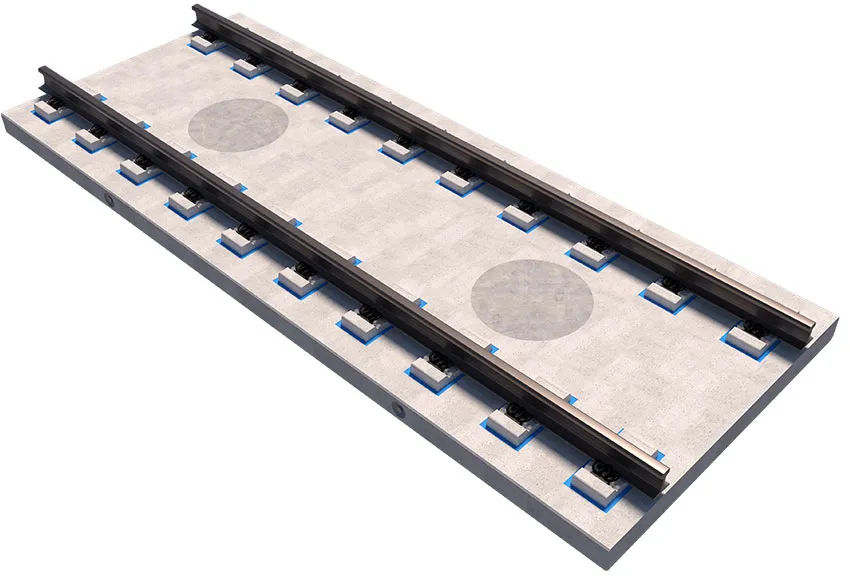
TINES® SLAB TRACK EBS Ballastless Track System forms a rigid, monolithic track structure that differs from a conventional railway track mainly due to the absence of traditional ballast and standard railway sleepers. Instead, it uses a durable concrete slab that ensures highly stable track geometry maintenance over a long period of operation. As a result, the need for maintenance works such as tamping or track alignment adjustments is significantly reduced. At the same time, this solution enables safe railway operation at very high speeds and in locations where high durability and resistance to dynamic loads are required.
The track structure of the TINES® SLAB TRACK EBS Ballastless Track System consists of several essential layers. The uppermost elements are the rails, which are fixed to the structure using dedicated elastic rail fastening systems. These fastenings ensure the maintenance of proper track geometry and provide the elasticity required for vibration damping and the transfer of loads generated by passing rail vehicles. The rails are mounted on prefabricated blocks placed in recesses within the track slab. These elements are positioned with high geometric accuracy and then embedded with TINES® Polyrail 60 polyurethane elastomer, resulting in the creation of a uniform, monolithic track structure.
System components
The main load-bearing element of the system is the TINES® ST EBS track slab, made of reinforced concrete and manufactured in a prefabrication plant. The track slab typically has a thickness of several dozen centimetres and is designed to evenly distribute axle loads from rail vehicles onto the lower structural layers.


The slabs are equipped with technological stabilising openings located along the track axis, which are filled with self-compacting concrete during system installation. This solution prevents the prefabricated element from lifting and shifting in relation to the established track axis. The spacing of the block support recesses is individually agreed with the customer and depends on the required operational parameters of the track. The typical spacing of rail block supports ranges from 500 to 850 mm.
Standard prefabricated track slabs used in railway and metro infrastructure have the following parameters:
- width: 2100–2400 mm
- height: 180–260 mm
- length: 2980–5980 mm
The slabs are manufactured in a rectangular shape, and their thickness can be adjusted to the designed axle loads of rail vehicles and the investor’s requirements.

During the prefabrication process, prefabricated rail block supports together with the TINES® W14 rail fastening system are embedded into the slabs using TINES® Polyrail 60 polyurethane elastomer (an elastic encapsulation layer).

Rail block supports with TINES® EBS encapsulation are an element of the ballastless track structure in which the rails are point-supported on prefabricated concrete blocks embedded in an elastic TINES® Polyrail 60 elastomer coating. The TINES® W14 direct rail fastening system is installed on these supports.

The TINES® W14 elastic rail fastening system is designed for point support and point fastening of the rail to ensure the required track gauge and clamping force, preventing the rail from shifting from its defined position. The use of Skl14 elastic clips with a central loop positioned above the rail foot ensures system flexibility, eliminating the risk of clip arm overloading and permanent deformation, while also preventing rail rotation. The angular guides transfer the pressure from the elastic clip and ensure its correct positioning, as well as provide electrical insulation between the rail, elastic clip and fastening screws. The angular guides also enable horizontal track gauge adjustment, including track widening in curves. The under-rail pad, installed beneath the rail foot and dimensionally adapted to the rail profile, provides electrical insulation between the rail and the TINES® ST EBS track slab and reduces the transmission of dynamic loads to the slab. In some variants of the TINES® SLAB TRACK EBS Ballastless Track System, an elastic layer or vibration isolation mats(such as TINES® Polymat STM or TINES® Rubbermat STM, are also used) they are installed between the track slab and the foundation layer. Their purpose is to reduce vibration transmission to the surrounding environment and improve ride comfort.
Below the TINES® ST EBS track slab there is a foundation layer that provides structural support for the entire track system. It may consist of a blinding concrete layer, stabilised aggregate, or another reinforced subgrade structure. This foundation must have very high load-bearing capacity and ensure uniform settlement, as ballastless track systems do not include a crushed stone ballast layer that, in conventional tracks, compensates for minor irregularities in the subsoil.
Therefore, the subgrade is carefully prepared and often reinforced with additional structural layers to ensure long-term stability and durability of the track system.
System applications
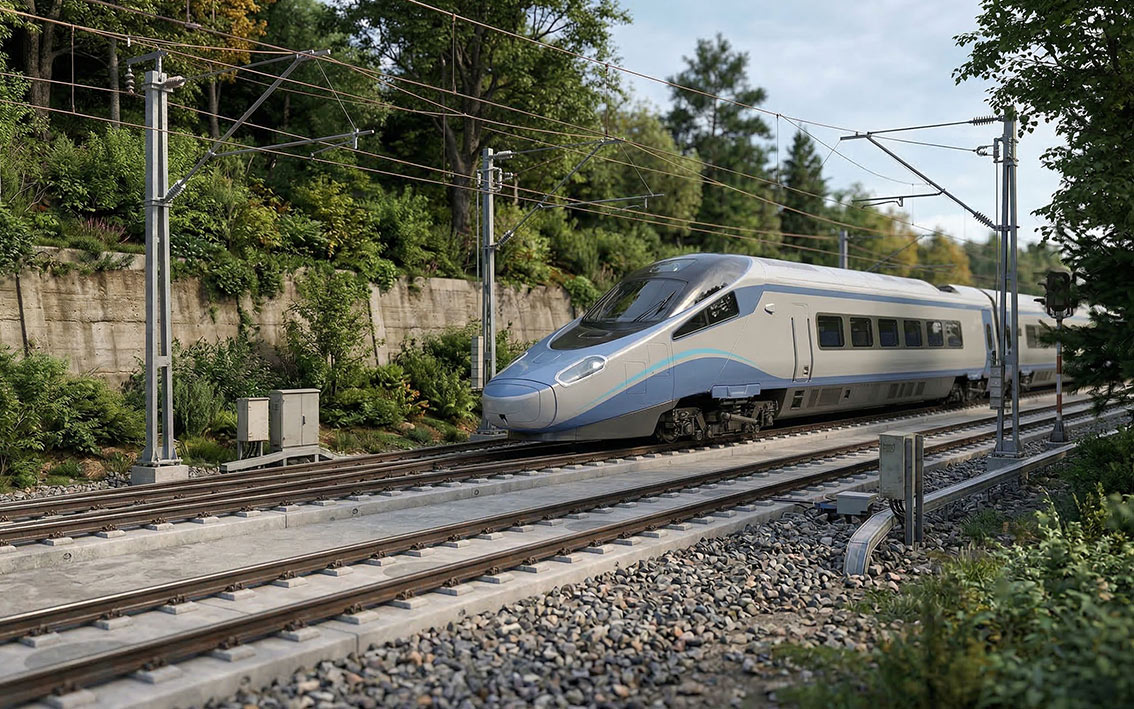
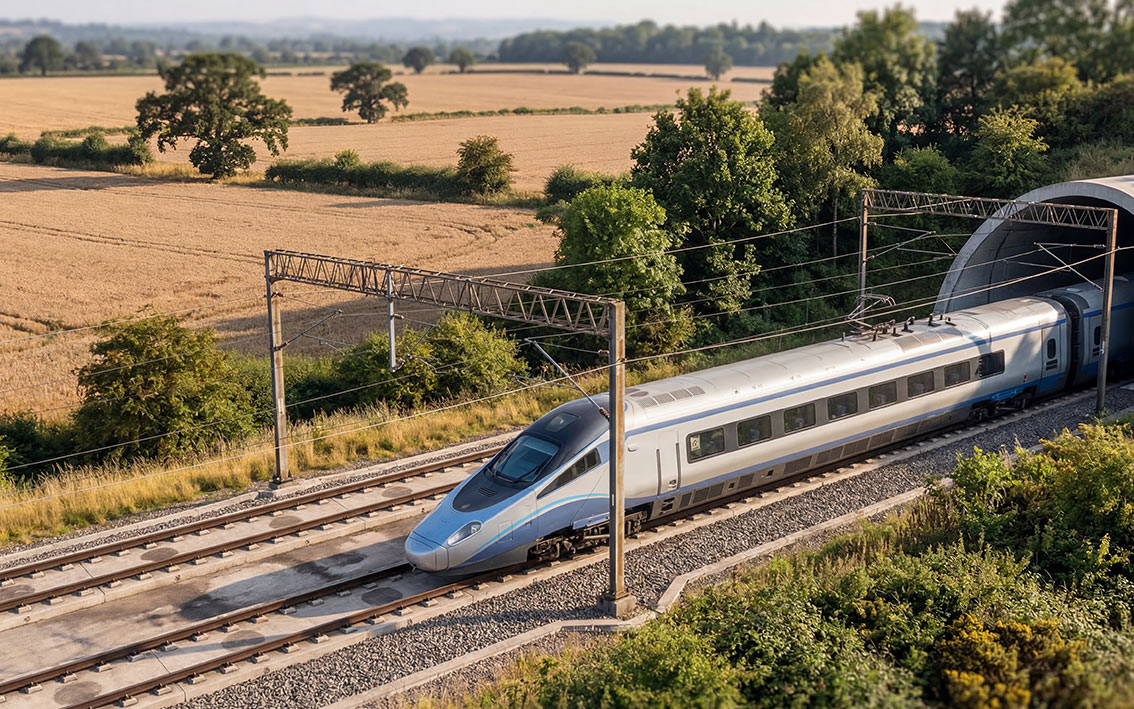
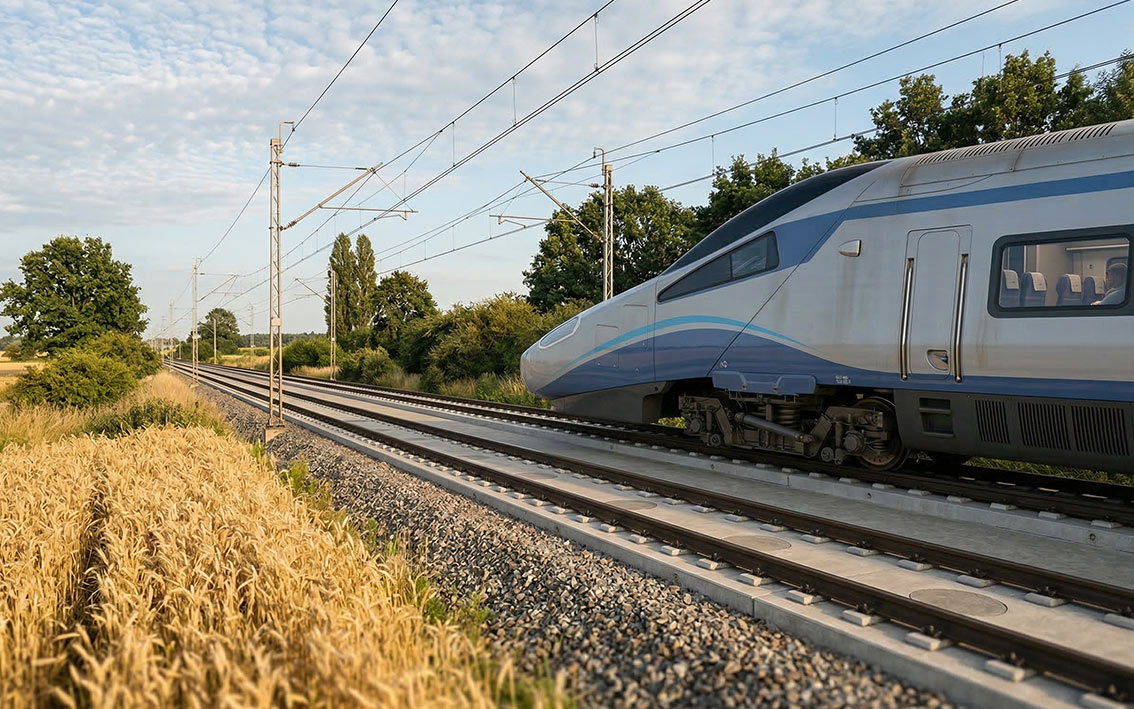
The TINES® SLAB TRACK EBS Ballastless Track System is used in locations where very high track durability, excellent geometric stability, and reduced maintenance requirements are essential. The solution is primarily applied on modern high-speed and heavily trafficked railway lines, where conventional ballasted track structures would require frequent repairs and alignment works. One of the key application areas of the system is high-speed railway lines. Thanks to its rigid, monolithic concrete structure, the track maintains highly stable geometry even under train operations at speeds exceeding 250–300 km/h. Under such conditions, traditional ballast deteriorates and deforms more rapidly; therefore, ballastless solutions provide higher efficiency and improved operational safety.
System advantages
- High structural durability – the service life of the track is significantly longer than in the case of ballasted track structures (up to several decades).
- Highly stable track geometry – the concrete slab ensures the constant position of the rails and limits track deformation.
- Low maintenance costs – the absence of ballast eliminates the need for track tamping and frequent alignment adjustments.
- Capability of high-speed operation – the system is designed for high-speed railway lines.
- High resistance to significant dynamic loads – the system effectively transfers loads generated by heavy and high-speed trains.
- Excellent stability on engineering structures – suitable for use on bridges, viaducts, and in tunnels.
- Possibility of reducing vibration and noise – the use of elastic components helps minimise the impact on the surrounding environment.
- Reduced consumption of maintenance materials – no need for regular replenishment or replacement of crushed stone ballast.
- High level of operational safety – the stable structure reduces the risk of track deformation.
To prepare a technical and commercial offer, please contact: handlowy@tinesrail.com