
Integrated Tram-Road Surface System
TINES® TRAM GTP
The TINES® TRAM GTP integrated tram-road surface system is a modern, ballastless track structure designed for use at tram-road level crossings and pedestrian crossings. This solution enables a durable and safe combination of tram track functionality with the road surface, ensuring a high level of user comfort and operational reliability.
System description
The TINES® GTP integrated rail-road surface system is a modern, ballastless tram-road surface structure designed for use at tram-road level crossings and pedestrian crossings along tram lines. This solution enables a durable and safe combination of track functionality with the road surface, while ensuring a high level of user comfort and operational reliability. The TINES® TRAM GTP integrated rail-road surface system allows for safe and durable carrying of wheeled vehicle traffic and tram rolling stock within a single, common load-bearing structure.
A key element of this system is the TINES® TRAM LC-L W14 prefabricated slab, made of high-strength concrete. This element serves as the main load-bearing layer and shapes the track geometry, replacing the crushed stone ballast used in ballasted track structures as well as rail supports, which are most commonly sleepers.
Rail channels are formed in the track slab to enable precise positioning of the rails. The rails are fastened in the channels using the TINES® W14 point elastic rail fastening system, which provides stable and durable rail fastening while maintaining the required elasticity of the track system. The fastening system used compensates for thermal deformations, reduces vibration transmission, and contributes to the reduction of noise generated during rolling stock passage.
The TINES® TRAM GTP integrated rail-road surface system can be used on single-track or multi-track lines in tracks of all classes, with track gauges including 1000 mm, 1435 mm, or 1520 mm, with 49E1 and 60R2 rails, on straight sections, or in curves.
The TINES® TRAM GTP system allows for a significant reduction in the scope of maintenance work, and the prefabricated nature of the elements enables fast assembly and potential disassembly of the surface with minimal interruptions to tram and road traffic. The system meets the requirements of modern transport infrastructure, combining durability, functionality, and operational safety.
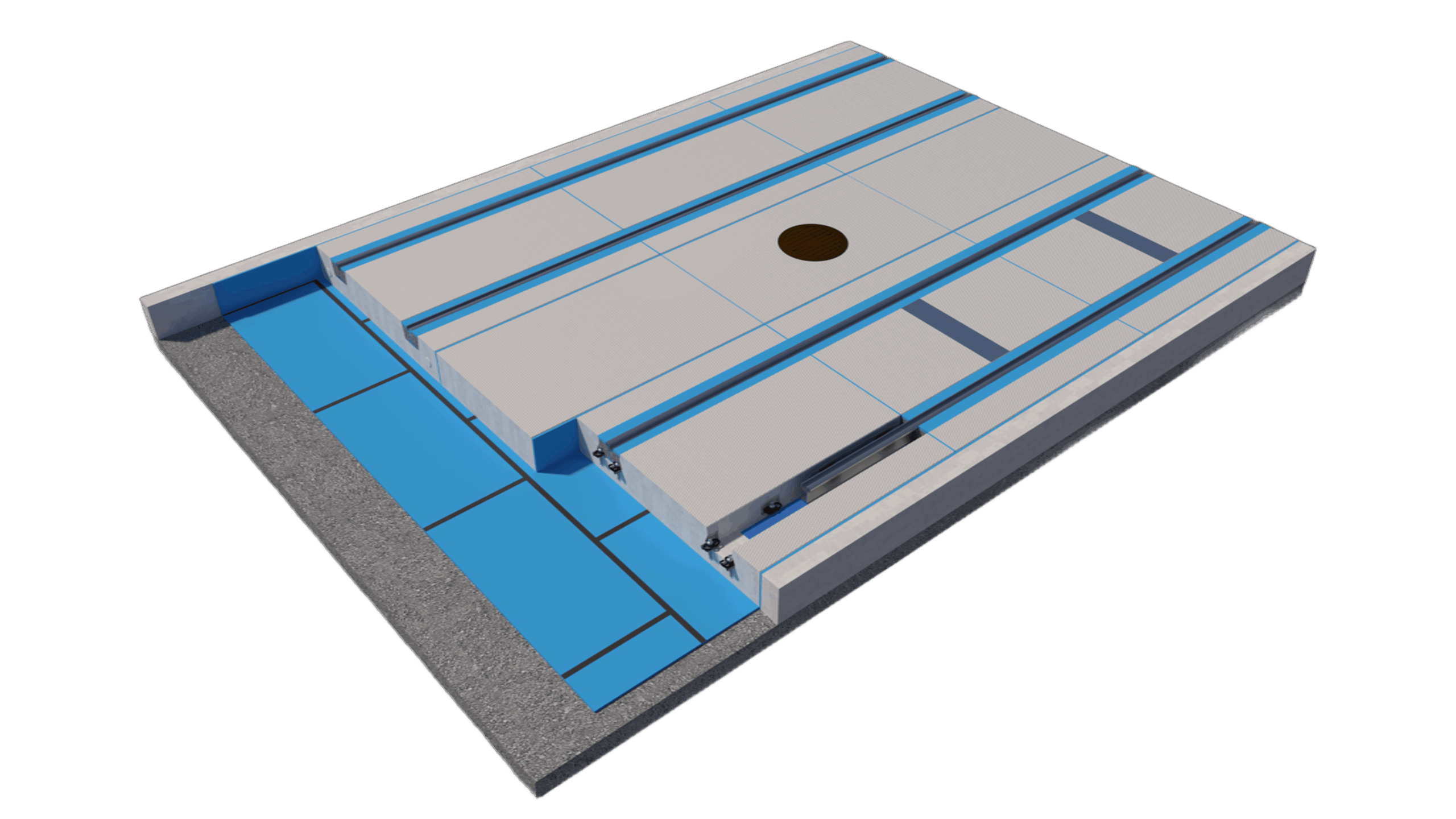


System Components
Basic elements of the system
- TINES® TRAM LC-L W14 slabs are manufactured as standard in modules that, in top view, form an isosceles trapezoid with base lengths of 2.57 and 2.60 m. The cross-section of the slab is rectangular. Rail channels are formed within these slabs to allow for precise positioning of the rails. The selection of dimensions for TINES® LC-L W14 slabs depends on the track geometry and local conditions.
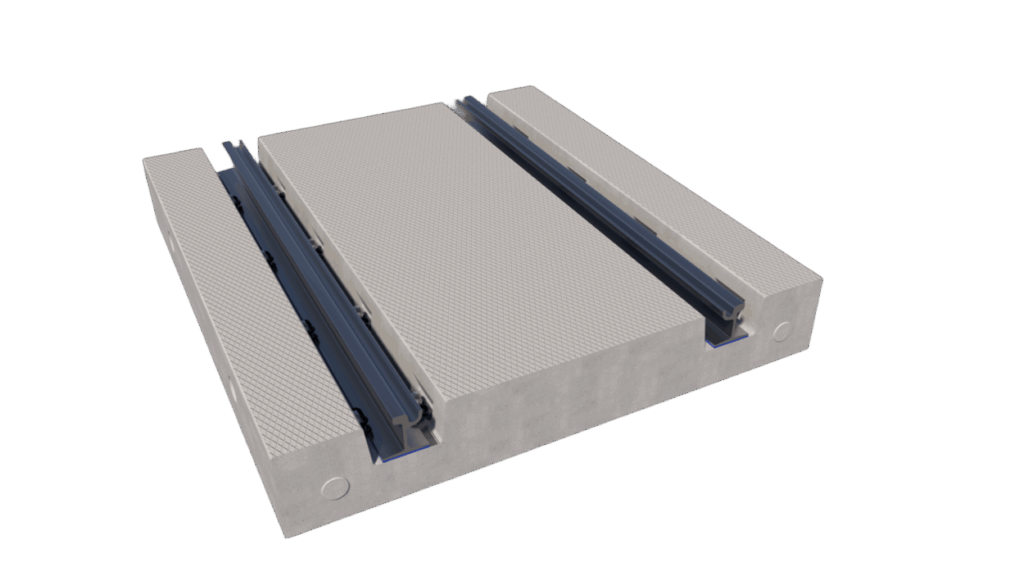
- TINES® W14 resilient rail fastening system. It is a type of direct, point rail fastening. The use of the SKL 14 elastic rail clip with a middle loop positioned over the rail foot ensures the system’s elasticity, which eliminates the risk of overloading the clip arms and their plastic deformation, while also preventing rail rotation. Angle guides transfer the pressure of the elastic clip onto the rail foot, ensuring its correct positioning and providing electrical insulation between the rail, the elastic clip, and the mounting bolts. The TINES® Railstrip continuous elastic rail pad, laid under the rail foot and dimensionally adapted to the rail profile, ensures electrical insulation between the rail and the track slab and limits the dynamic impacts transferred to it.

System Application
The TINES® TRAM GTP integrated tram-road surface system is used in modern tram investments requiring a durable, aesthetic, and integrated track-road surface. The solution is primarily dedicated to:
- tram tracks shared with the roadway,
- tram-road level crossings,
- pedestrian crossings and areas with increased urban traffic,
- bus lanes and routes with restricted traffic access,
- city centers and densely built-up areas,
- spaces requiring noise and vibration reduction, so-called “quiet zones”,
- modernization projects and new tram lines,
- areas with high aesthetic and urban requirements.
System Advantages
- Reduction of dynamic impacts – the use of point resilient rail fastening effectively limits the transfer of dynamic forces generated by rail vehicle traffic. This allows for a reduction in loads acting on both the track structure and the road surface elements, as well as the surrounding infrastructure.
- Effective noise and vibration damping – the resilient rail fastening system reduces the level of vibration and noise emitted during the passage of rail vehicles, improving the comfort of road users and residents of adjacent areas.
- Simple installation and short implementation time – the use of prefabricated structural elements delivered directly to the construction site significantly accelerates the surfacing process, limits the scope of wet works, and shortens infrastructure downtime.
- Full integration of track and road surfaces – the system allows for the creation of a uniform structure where the track is an integral part of the roadway. This solution ensures an aesthetic appearance and a comfortable, safe passage for road vehicles across the track.
- Adaptability to local conditions – the modular design of the system allows for the engineering of solutions that meet individual investment requirements, including various lane widths, track geometry, and local technical conditions.
- High load-bearing capacity and resistance to operational loads – the structure is designed to transfer loads from both tram traffic and heavy road traffic, maintaining durability and stability of performance parameters throughout the entire service life.
- Elimination of vertical track irregularities – the precision manufacturing of prefabricated elements and systemic installation solutions ensure the required track geometry is maintained, limiting the formation of irregularities that affect ride comfort and infrastructure durability.
- Electrical insulation and protection against stray currents – the system provides electrical insulation for the rails from the surface structure, reducing the risk of stray currents, which can lead to accelerated corrosion of metallic infrastructure components.
- Uniform and limited settlement of track and roadway – the appropriately designed structure ensures an even distribution of loads onto the substructure, minimizing settlement differences between the track and the road surface and limiting the need for subsequent repairs.
- Effective surface drainage – systemic design solutions enable efficient drainage of rainwater from the road and track surfaces, increasing the durability of the structure and operational safety.
- Low maintenance costs – the high quality of materials used, the durability of prefabricated elements, and the reduction in maintenance work result in lower operational and infrastructure maintenance costs throughout the facility’s entire life cycle.
- High durability and resistance to atmospheric factors – the materials and construction solutions used ensure resistance to changing climatic conditions, moisture, frost, de-icing salts, and heavy operational loads, guaranteeing many years of reliable system operation.
For the preparation of a technical and commercial offer, please contact handlowy@tinesrail.com
